Paper: Scalable Multi-Robot Collaboration with Large Language Models: Centralized or Decentralized Systems?
Github: GitHub - yongchao98/multi-agent-framework: LLM multi-agent discussion framework for multi-agent/robot situations.
Key Idea
4 robots-in-a-warehouse tasks with incremental difficulty, Tested on 4 different Archs
The Archs in question:
They differ in how they coordinate and manage information about their plan
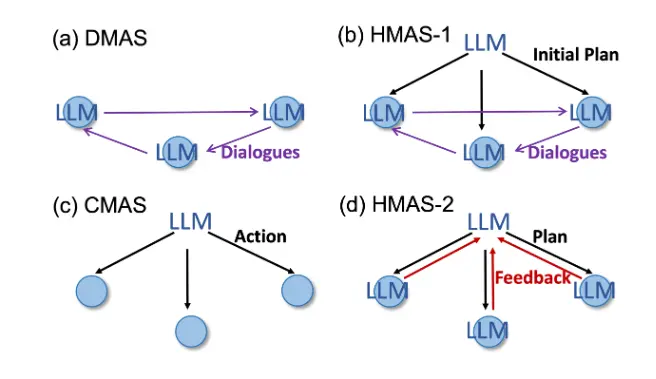
Figure from Chen et al. 2024, arXiv:2309.15943. Open full size
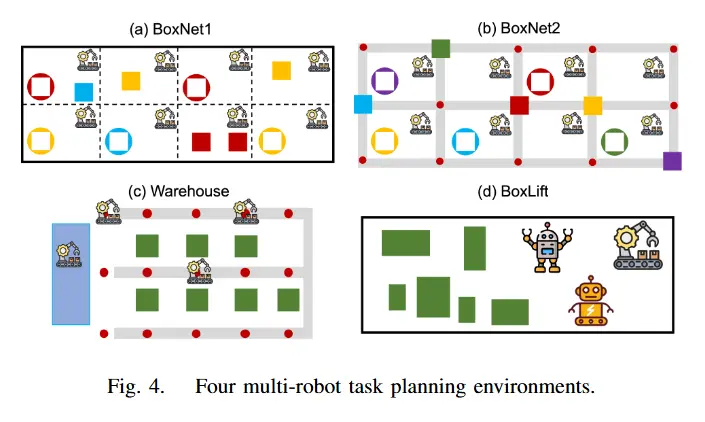
But we probably need the tasks more, the authers propose 4 tasks; from their paper:
| Task | Robots | Goal | What makes it hard | Collision? |
|---|---|---|---|---|
| BoxNet1 | 4, 8, 16, 32 arms | Move each colored box to its goal of the same color. Each arm stays in its cell. | Boxes must pass from cell to cell through many arms. | no |
| BoxNet2 | 4, 8, 16, 32 arms | As BoxNet1, but a box moves between cells only through a cell corner. | A corner holds only one box at a time. | yes |
| Warehouse | 4, 6, 8, 10 mobile robots | Bring all boxes to the target region along fixed paths. | Two robots on the same location is a collision. Six actions per robot. | yes |
| BoxLift | 4, 6, 8, 10 robots | Lift every box in the fewest steps. | Heavy boxes need several robots together. The agents see box size but not box weight. | no |
Results
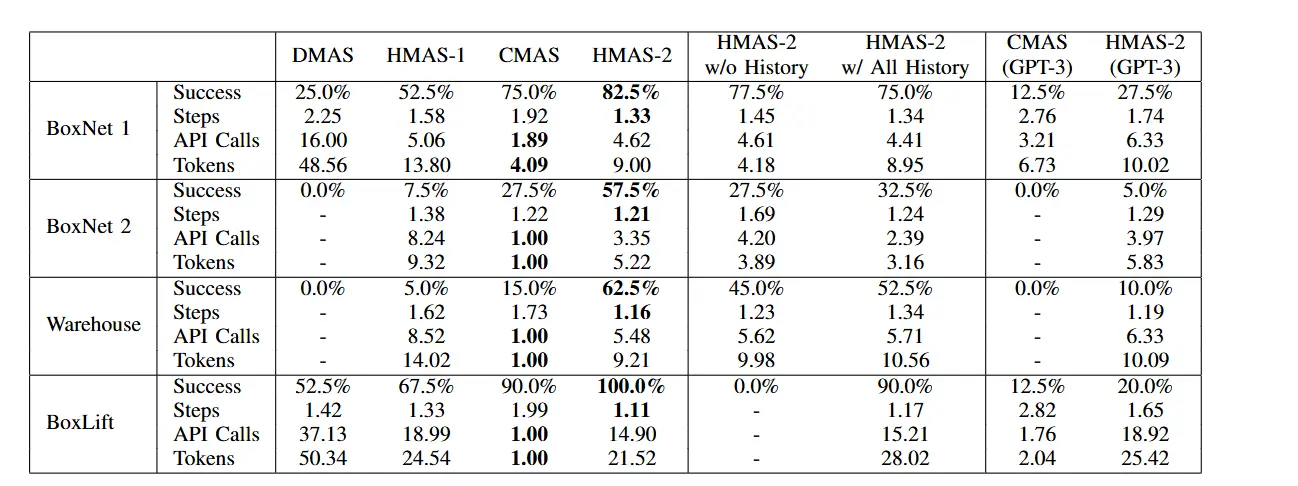
The HMAS-2 is the most successfull, but not the most efficient one, We can take this as a priority problem. If we told the selector we need less tokens spent, HMAS is a bad choice and should favor the centerlized one. others are irrelevant thu which is gonna make it more or less a binary problem.